"Your Dog's Itching, Scooting, and Paw Licking Aren't Allergies. Here's What 19 Years of Veterinary Practice Taught Me About What's Actually Going On."

If your dog has been scratching, scooting, or licking his paws raw and nothing has fixed it, I need you to read this.
Not because I have a product to sell you.
Because I spent 19 years in a veterinary practice telling owners exactly what your vet told you.
And I was wrong.
The itching isn't allergies. The scooting isn't anal glands. The paw licking isn't a habit.
They're symptoms. The actual cause is something most vets in the United States are not trained to test for in adult dogs.
I know this because I was one of those vets.
For 19 years, I prescribed medications that stopped the symptoms. I sent dogs home looking better. Owners called me grateful.
And the whole time, the thing causing the itching was still there. Still feeding. Still multiplying. Still destroying the gut lining from the inside.
The medication was putting a band-aid on a bullet wound. And the wound was coming from inside his gut.
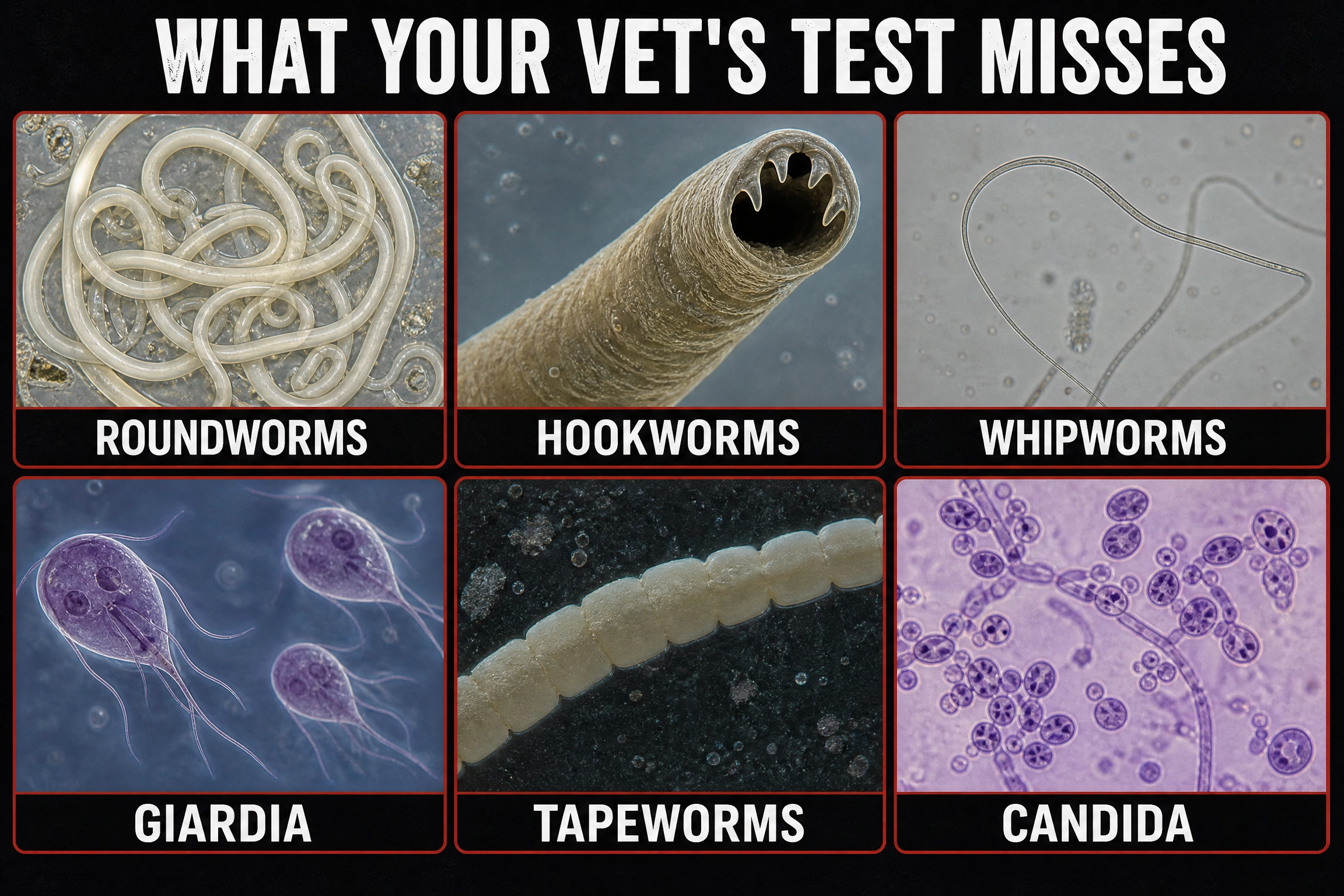
Standard fecal float tests miss up to 70% of these infections. Your vet ran the standard test. It came back "clean." That does not mean your dog is parasite-free.
The Diagnosis Your Vet Keeps Missing
I practiced veterinary medicine for 19 years. I saw thousands of dogs with chronic itching, paw licking, scooting, and recurring ear infections.
Every single one of them got the same answer: allergies.
Environmental allergies. Food allergies. Seasonal allergies. Atopic dermatitis.
And the treatment was always the same: suppress the symptoms.
Apoquel. Cytopoint. Medicated shampoos. Elimination diets. Steroid shots.
The most common was Apoquel. It's a JAK inhibitor that suppresses the immune pathways responsible for the inflammatory response. Within four days, most dogs stop scratching.
The owner is thrilled. The dog seems better. I felt like I was helping.
But here's what I didn't understand until year 19:
The itching was never the disease.
It was the immune system screaming that something was wrong in the gut.
And every treatment I was prescribing was silencing the scream.
Duke. 5-year-old Lab mix. Chronic paw licking, ear infections, scooting, red inflamed belly.
Full allergy workup. Skin scraping. Bloodwork. Allergy panel.
Result: "Environmental allergies."
I prescribed Apoquel 16mg once daily. Within four days, Duke stopped licking his paws. Sarah, his owner, called me: "Dr. Simmons, this is a miracle. He's like a new dog."
Month two: a lump on his side. Lipoma. "Probably benign. We'll monitor it."
Month four: another lump on his leg.
Month five: Duke was tired all the time. Recurring ear infections. His third round of antibiotics since starting the medication.
Month six: bloodwork. Liver values elevated. ALT climbing.
Month eight: a fourth lump. This one felt different.
I aspirated it. Sent it to the lab.
Mast cell tumor. Grade 2. In a 6-year-old dog.
Apoquel is a JAK inhibitor. It suppresses the immune pathways responsible for identifying and eliminating abnormal cells. The manufacturer's own studies showed increased rates of new growths in dogs on long-term Apoquel.
Duke was 5 years old with no history of lumps before he started the medication.
Sarah asked me: "So I've been giving him something that stops the itching but lets the growths happen?"
I didn't finish the sentence. I didn't have to.
What the Research Actually Says
Month ten, I attended a veterinary parasitology lecture at a conference.
The speaker showed data I had never seen before.
Dogs with chronic "allergy" symptoms — the paw licking, the scratching, the ear infections, the hot spots — were tested for parasites using PCR panels instead of standard fecal floats.
I felt like I'd been punched in the stomach.
For 19 years, I had been prescribing a drug that turned off the alarm while the house burned down.
The Worst Part
Here's what makes this so devastating.
Your dog's gut was designed to defend itself.
It has a mucosal barrier. A thick protective lining reinforced by specific antimicrobial compounds that traps parasite eggs before they can attach, paralyzes larvae, and creates an environment so hostile that nothing survives long enough to colonize.
But that defense requires specific compounds to be maintained. Every single day.
Your dog is exposed every single day. Here's how:
- 🌿 Grass at the dog park. Parasite eggs survive in soil for years. Every morning walk is an exposure event.
- 💧 Puddles on walks. Giardia cysts live in standing water. One lap. That's all it takes.
- 🐾 Sniffing other dogs. Direct fecal-oral transmission. Happens in seconds.
- 👟 Your shoes. You track parasite eggs inside every single day. He licks the floor. He licks his paws.
- 🥩 Raw meat and contaminated treats. Even "premium" treats can carry larvae.
- 🌱 Eating grass. Dogs eat grass instinctively. It's coated in eggs from other animals.

X-ray visualization: parasites attached to the gut lining, actively feeding. This is what the standard fecal test doesn't find.
What happens when the barrier collapses:
- ✗ Parasites attach to the gut lining and begin feeding
- ✗ The immune system triggers systemic inflammation — showing up as itching, paw licking, scooting, ear infections
- ✗ The inflammatory cascade goes to the skin because the gut is the source
- ✗ Apoquel silences the immune response. The parasites multiply unchecked.
- ✗ Gut lining continues to thin. Nutrient absorption fails. Slow decline begins.
Why Every Common Solution Fails
Failure.
Failure.
Failure.
Failure.
Failure.
Failure.
What I Found When I Actually Looked
After that conference, I went back to my practice and called Sarah.
"I want to try something with Duke. It's not standard protocol, but I think it might help."
I started him on daily gut defense. Clinical-concentration compounds. The four specific ingredients the gut barrier requires every single day to stay hostile to parasites.
And I kept him on the Apoquel. Because you have to fix the gas leak while the fire blanket is still on.
Week one: No change.
Week two: Duke's ear infection cleared up without antibiotics for the first time in months.
Week three: Sarah called. "He's not licking his paws as much. Even on the Apoquel, he was still doing it a little. Now he's stopped completely."
Week four: Bloodwork. Liver values starting to come down.
Week six: I tried tapering the Apoquel. Cut the dose in half.
Day 1: No itching. Day 2: No itching. Day 7: Still no itching.
Week ten: I took Duke completely off Apoquel. He'd been on it for 10 months.
It never came back.
Week twelve: Full panel. Liver values normal. No new lumps in two months. Energy back. Ears clean. Paws pink and healthy.
Sarah brought him in for his three-month check-up.
"Dr. Simmons, I don't know what you did, but Duke is the dog I had three years ago. Before all of this started."
I stared at my desk for a long time.
"Sarah, I'm so sorry. I could have done this 10 months ago. Before the liver damage. Before the lumps."
She reached across the table and squeezed my hand.
"You know now."
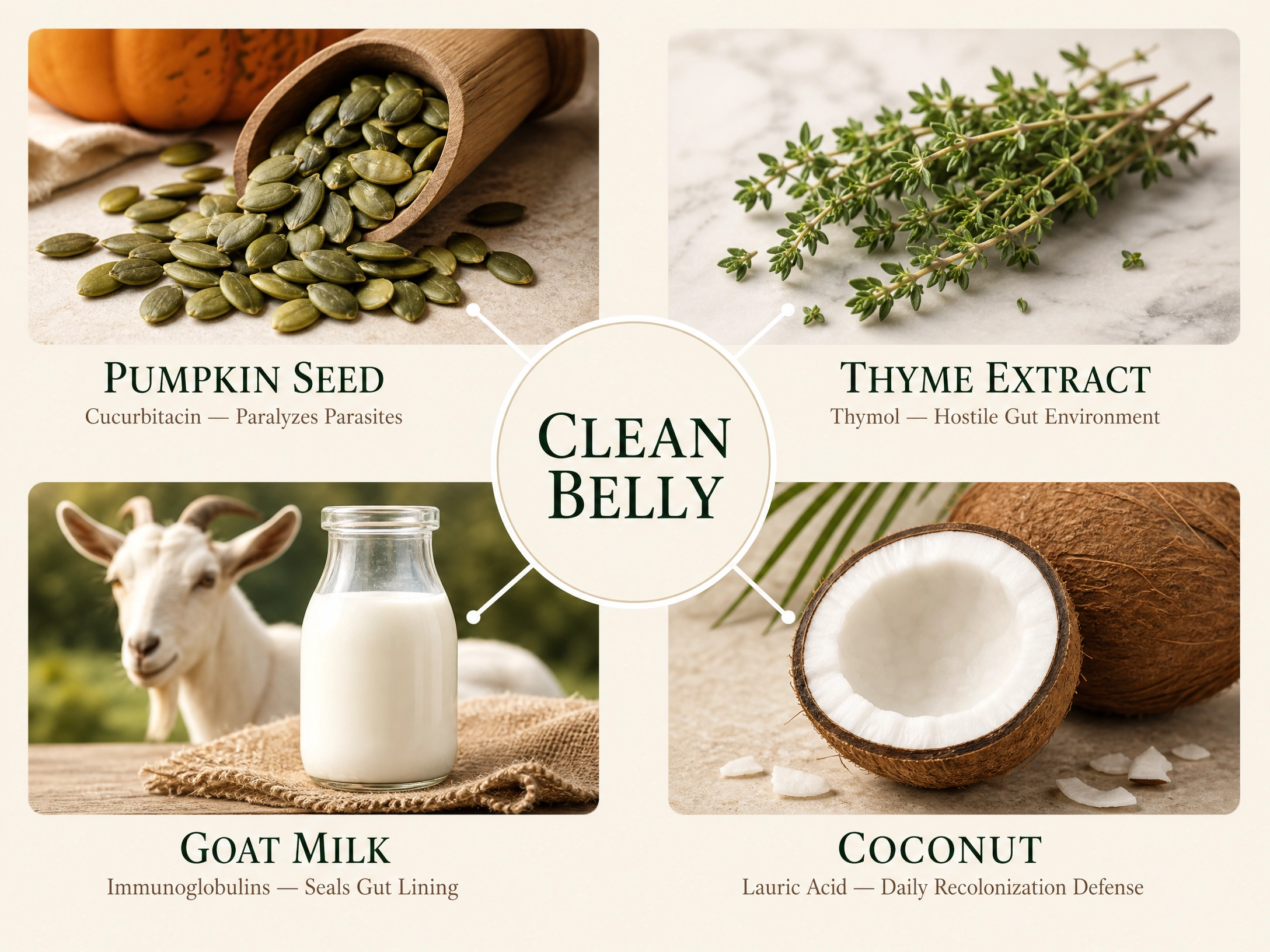
Four food-grade ingredients at clinical concentrations. Third-party lab tested. Every batch.
The Protocol That Actually Works
I then tested every gut health supplement I could find. I sent them to an independent lab.
The results were ugly.
The bestselling "gut health" chew on Amazon claimed clinical levels of pumpkin seed extract. Actual cucurbitacin content: negligible. Nowhere near enough to maintain a hostile environment.
Three brands were cut with rice flour and maltodextrin. Fillers that actually irritate the gut lining further.
Two brands had no measurable active compounds at all. Just flavored treats in a labeled bag.
Only one product passed every test I ran across three separate batches.
Clean Belly.
Paralyzes parasites at every life stage. Maintains a hostile gut environment daily. Verified at clinical concentrations, not trace amounts.
Broad-spectrum antimicrobial defense. Creates an environment nothing survives in. At therapeutic concentrations, not the decorative amounts in most supplements.
Seals the gut lining. Prevents parasite attachment. Rebuilds the mucosal barrier that Apoquel and processed food have been eroding.
Daily defense against recolonization. Once the parasites are flushed, this keeps the environment hostile so they can't come back.
One chew. Into whatever food he already eats. Once a day.
Your dog will eat it like a treat. These are the same compounds farm dogs get from the land every single day, concentrated into a daily chew so house dogs can get them too.
What Happened When I Started All 41 Dogs
I went back to my practice. I tested every "allergy" dog on Apoquel for parasitic colonization using PCR panels instead of standard fecal floats.
Out of 41 dogs tested: 38 had active parasitic colonization the standard test had missed.
93%.
I started all of them on daily gut defense at clinical concentrations while keeping them on their current Apoquel dose.
Within 6 to 8 weeks, 34 of them were able to taper off Apoquel completely. No flare-ups. No relapses.

"My dog Theo had been scooting every single day for four months. Three vets told me it was anal glands or allergies. Started Clean Belly after reading about the gut barrier connection. Day 4, the scooting stopped. Completely. After four months of daily scooting, gone. Day 21, the paw licking stopped. Day 30, his coat looked different. Fuller. Shinier. I drove him back to a parasitologist for a follow-up. Parasites gone. Gut barrier rebuilding. I wish I had known about this eight months ago."

"Cooper had chronic soft stool for eight months. Vet ran a standard fecal float. Came back clean. Kept telling me it was a sensitive stomach. Tried every food, every probiotic. Nothing worked for more than two weeks. Emergency vet visit. Fecal PCR, not the standard test. Hookworms and Giardia. Gut lining significantly compromised. Started Clean Belly after the diagnosis. Week 3, his stool firmed up and stayed firm for the first time in eight months. Week 6, I found parasites in his stool. The daily gut defense was flushing what the dewormer had missed. Week 8, follow-up bloodwork. Inflammatory markers down. Gut lining rebuilding. His stool has been firm every single day for 12 weeks."

"Rosie was on $85-a-bag grain-free food for six years. I thought I was doing everything right. She started scooting around her fifth birthday. Vet said anal glands. Then she slowed down. Vet said early arthritis. Then at 2:47 in the morning I woke up to a sound I will never forget. Found her on the bathroom floor, shaking, with live worms visible. Emergency vet. Severe parasitic infestation. Gut lining severely compromised. The grain-free food with peas and lentils had been creating micro-perforations in her mucosal barrier for years. I found Clean Belly after she passed. I now give it to my new dog from day one. One chew every morning. I will never go without it again."
What to Expect Week by Week
You Don't Have to Wait Any Longer
If your dog's itching started mild and has been slowly getting worse over months, you don't have to wait.
If the Apoquel "works" but something still feels off, you don't have to wait.
If you've been told it's allergies but it never fully resolves, you don't have to wait.
What pattern are you actually seeing?
Scooting plus paw licking plus scratching plus coat changes. That pattern is almost never allergies. That pattern is systemic inflammation from a compromised gut.
The symptoms are the first domino. Organ damage is the last one.
By the time it becomes obvious to the eye, the intestinal damage is often severe enough that it's very difficult to reverse.
Trusted by Practitioners
I am not paid by Clean Belly. I do not receive a commission.
I am a veterinarian who spent 19 years prescribing a drug that silenced symptoms while the underlying cause got worse. I walked away from private practice two years ago because I could no longer in good conscience follow a protocol I knew was incomplete.
I tested Clean Belly three times across three separate production batches.
Verified cucurbitacin at clinical levels every time. Antimicrobial thyme at therapeutic concentrations every time. Active immunoglobulins every time.
Clinical levels versus trace amounts. Those are not two versions of the same thing. One maintains daily defense. One lets the barrier collapse while you believe you are maintaining it.
"Of 41 dogs on Apoquel for chronic itching that I tested with PCR panels, 38 had active parasitic colonization the standard test had missed. 93%. All of them trapped in the medication cycle. Within 6 to 8 weeks of daily gut defense, 34 were able to taper off Apoquel completely. No flare-ups. No relapses." — Dr. Laura Simmons, DVM
Compare What You're Actually Spending
If the itching doesn't resolve, you pay nothing. 60-day money-back guarantee, no questions asked.
⚠ Stock is limited. Demand has increased significantly as more dog owners learn about the gut barrier connection.
I now know what to tell owners when their dog is itching, scooting, and licking his paws raw.
I know what I would tell myself if I could go back.
Don't waste months on Apoquel while the underlying cause gets worse.
One chew. With whatever food he already eats. Once a day.
Give it six weeks. Watch for the ear infections clearing first. Then the scooting. Then the paw licking. Then the coat.
When he brings you a toy for the first time in months, that's when you know the gut barrier is rebuilding.
Your dog is still here. That is everything.
— Dr. Laura Simmons, DVM
P.S. Your dog doesn't have allergies. He has parasites that look like allergies because they trigger the exact same inflammatory response. Every medication your vet prescribed was designed to suppress that response. Not eliminate what's causing it. Now you know what to do about it.
Disclaimer: This article is for informational purposes only and does not constitute veterinary medical advice. Results described are individual experiences and may not be typical. Clean Belly is a dietary supplement and is not intended to diagnose, treat, cure, or prevent any disease. Consult your veterinarian before making changes to your pet's health regimen. Statements about Apoquel reflect the author's personal clinical observations and published research; individual outcomes vary.