Pet Health Review
These Parasites Have Been Living in Your Dog for Years. Your Vet's Test Was Built to Miss Them.
"The chronic scratching, the scooting, the indoor accidents, the 3AM pacing, the dull coat — they aren't five different problems. They're five symptoms of one root cause. And it's the cause most vets aren't trained to look for."
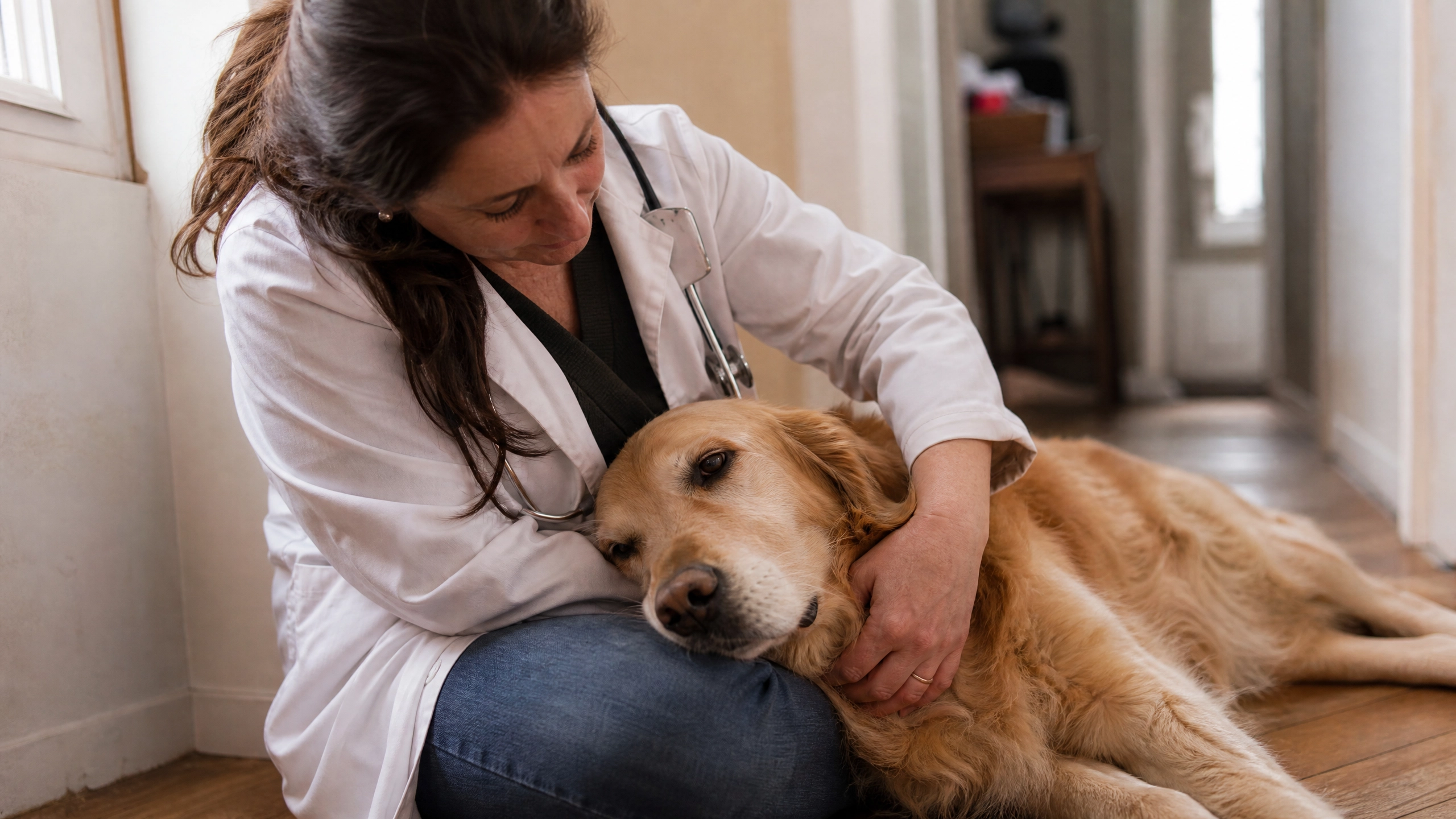 Want to skip ahead? Click to see the protocol I recommend to my patients
If your dog has chronic digestive or behavioral problems, you've probably tried what most owners do.
If you've bought Apoquel or Cytopoint...
If you've switched to prescription food...
If you've tried calming chews, CBD oil, training classes, and behaviorists...
And if your dog is still scratching, licking their paws raw, scooting across your carpet, having accidents inside, or pacing at 2-3AM... you are not alone.
I've spent over 16 years as a veterinarian, with the last 9 focused specifically on integrative and holistic care.
I've worked with thousands of dogs whose owners were told their problems were "just behavioral" or "just allergies" or "just getting older."
And what I've found shocked me: Nearly 80% of the medications prescribed for these symptoms only mask them.
They don't address the hidden cause.
They don't rebuild anything.
And that's why your dog still struggles. No matter how much you spend.

Most Owners Are Fighting the Wrong Battle
At first, it looks simple.
Your dog starts scooting.
Starts licking their paws at night.
Has an accident on the carpet.
Starts waking you up at 3AM, pacing.
So you follow what your vet recommends.
But here's what you're actually getting:
Apoquel + Cytopoint → suppress immune response for skin symptoms, offer short-term relief, don't rebuild the gut driving the inflammation.
Calming chews + anti-anxiety meds → sedate the brain, don't address why the nervous system is stuck in fight-or-flight.
Training classes + behaviorists → address the dog's behavior, don't address the biological reason the behavior exists.
Prescription food → removes potential allergens, doesn't repair the compromised gut lining letting those allergens through in the first place.
Standard dewormers → kill the adult worms visible on a fecal test, miss the eggs, larvae, and subclinical load your vet never detected.
That's why you notice small improvement... then nothing.
Because the real problem isn't the symptoms.
And that realization hit me during one of my hardest cases.
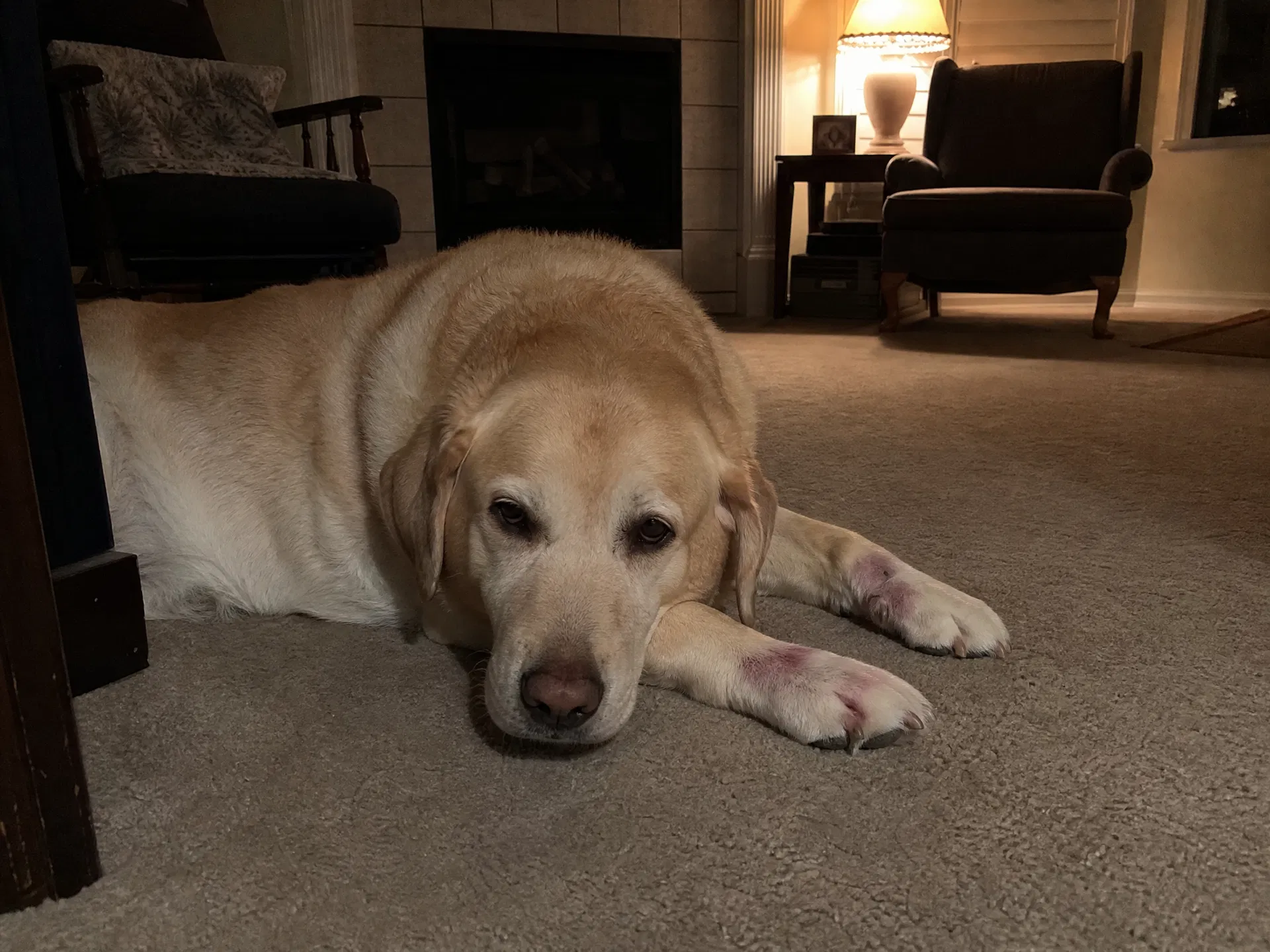
When Everything I Was Taught Failed in My Exam Room
Biscuit was a 5-year-old rescue, a German Shepherd mix his owner Karen had adopted three years earlier from a high-intake shelter in Tennessee.
Karen did everything right:
✅ Premium limited-ingredient food.
✅ Weekly medicated baths.
✅ Apoquel daily and monthly Cytopoint injections.
✅ Two different trainers, including a board-certified behaviorist.
✅ CBD oil, calming chews, and a Thundershirt for the nighttime pacing.
Still, Biscuit scratched his flanks raw every night.
Still, he scooted across the living room carpet three or four times a day.
Still, he had indoor accidents, even though Karen had retrained him twice.
Still, he paced the house between 2 and 3AM every single night, keeping Karen awake.
I prescribed stronger medications.
Nothing changed.
We tried a referral to a veterinary dermatologist.
His condition worsened.
Karen sat in my exam room in tears and asked the question that broke me:
"Why is he still suffering... when I've done everything they told me to do?"
I had no answer.
That night, I went home and made it my mission to find the real answer. No matter what it exposed about my profession.
I went back through every peer-reviewed paper I could find on the gut-skin connection, the gut-brain connection, and the link between parasites and chronic behavior problems.
And that's when everything changed.
The Shocking Hidden Cause: A Damaged Gut and Parasites Your Vet Never Found
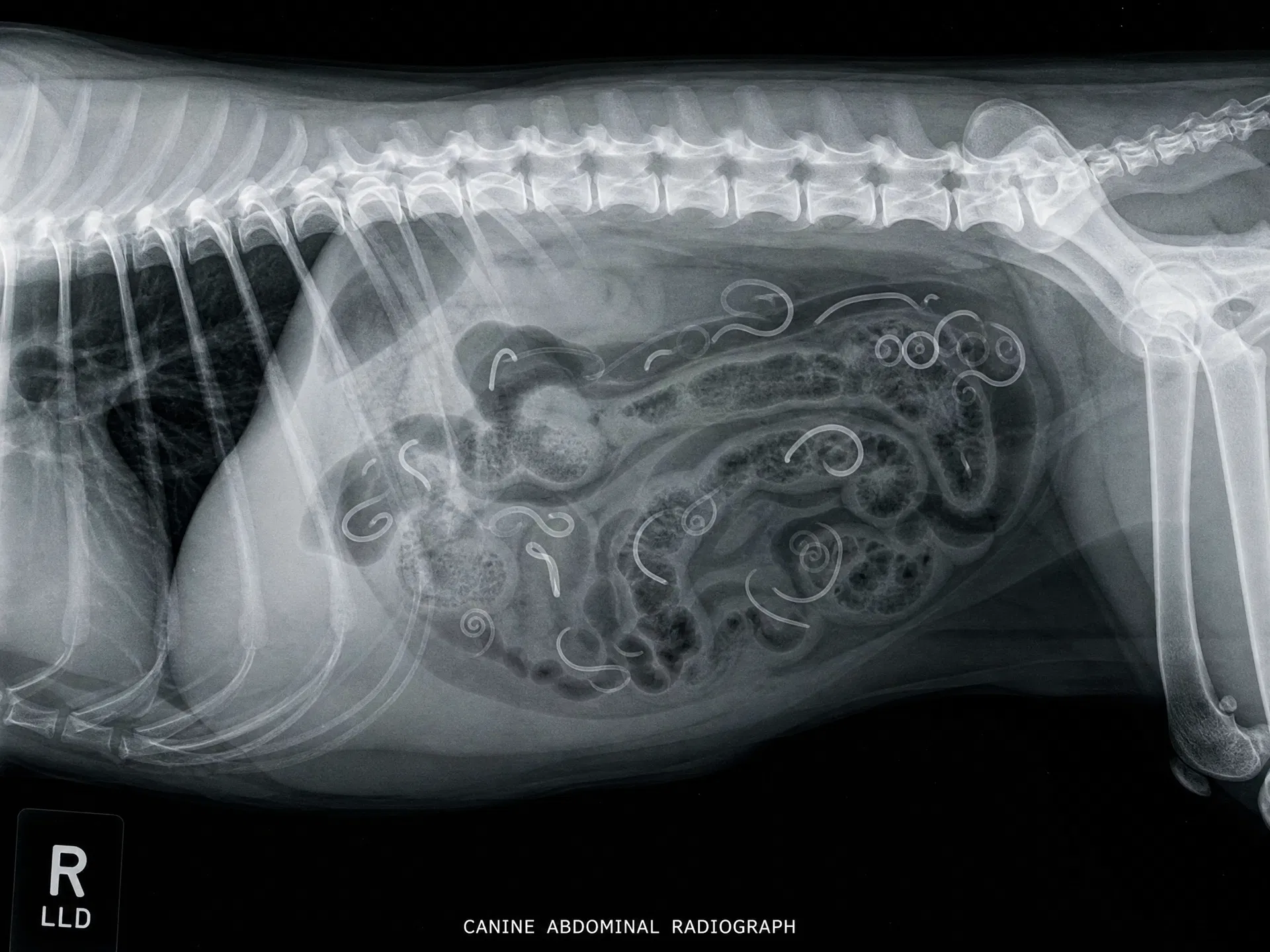
Actual canine abdominal radiograph. The coiled shapes inside the intestinal tract are parasites. This is what a standard fecal test misses.
We've been thinking about this backwards.
❌ It's not "just severe allergies."
❌ It's not "just behavioral."
❌ It's not "anxiety from his rescue past."
❌ It's not "he's just getting older."
The real hidden cause is this: Modern kibble, repeated antibiotics, environmental toxins, and shelter exposure break down your dog's gut lining, creating the perfect environment for parasites and harmful bacteria to move in and stay.
The gut lining — the protective wall that keeps pathogens out of your dog's bloodstream — is a single cell thick. When it breaks down, three things happen at the same time.
First, the good bacteria collapse. The beneficial bacteria that help produce your dog's calming hormones get pushed out by opportunistic organisms. Your dog's nervous system loses its natural stabilizer.
Second, parasites move in. Roundworms, hookworms, whipworms, and Giardia find a welcoming environment and settle into low-grade infections. Infections so mild that standard fecal tests miss them completely.
Here's a fact most owners never hear: 2020 research from the DOGPARCS study found that 85% of U.S. dog parks tested positive for intestinal parasites, and CAPC surveillance shows canine hookworm infections have increased 45% since 2012.
Your dog doesn't need to have visible worms to have a parasite problem.
Third, toxins leak. The damaged gut lining can no longer block irritants, parasite waste, and inflammatory compounds from entering the bloodstream. Once they're circulating, they trigger reactions everywhere: skin, behavior, sleep, digestion.
That's the chronic paw licking.
The scooting that won't stop.
The indoor accidents no amount of training fixes.
The 3AM pacing that keeps getting worse.
The reactivity on walks that your trainer can't resolve.
Medications suppress each individual symptom.
But they don't repair the gut driving all of them.
That's why they work temporarily... then fail.
The damage keeps getting worse.
If you've felt like you're going crazy spending thousands with no results... you're not crazy.
The treatments were never designed to fix this.
And here's what made me angry:
Integrative and holistic vets have known about the gut-skin and gut-brain connection for years. But conventional general practice vets aren't taught it in school. The knowledge gap has kept your dog suffering while you've been writing checks.
And the pharmaceutical companies? They make zero money if your dog gets better. A healthy dog doesn't need a $120/month Apoquel prescription. Doesn't need quarterly Cytopoint injections. Doesn't need annual allergy workups that cost more than your car payment.
Your dog staying sick is their business model.
There's no recurring revenue in fixing the root cause. So they don't teach it. They don't fund it. And they certainly don't advertise it.
Why Common Solutions Fail (And Always Will)
I tested every major treatment against this reality.
Apoquel? Suppresses the skin's immune response. Doesn't rebuild the gut. Failure.
Cytopoint? Blocks the itch signal. The gut keeps leaking underneath. Failure.
Calming chews? Sedate the brain for a few hours. Don't repair the gut producing the anxiety. Failure.
Standard dewormers? Kill adult worms visible on a fecal test. Don't touch eggs, larvae, or the damaged gut environment that let them take hold in the first place. The cycle restarts within weeks. Failure.
Omega-3 fish oil? Helps with inflammation. Doesn't address the source of the inflammation. Failure.
Probiotics alone? Support the good bacteria. Can't repopulate a gut that's still being taken over by harmful organisms. Failure.
They all miss the real issue: a damaged gut and a low-grade parasite load your vet never tested for.
Why didn't you know this? Because fixing the root cause isn't profitable. There's no recurring revenue in a dog that gets better. The system profits from the monthly Apoquel refill, the quarterly Cytopoint injection, the annual allergy workup.
Your dog staying sick is their business model.
The Protocol That Actually Addresses the Root Cause
Your dog's gut needs a complete approach that works on the parasites, repairs the gut lining, and restores the good bacteria at the same time.
Here's what actually makes a difference, based on the research and what I've seen work in my own practice:
Pumpkin Seed: Used for centuries to help the body expel intestinal worms naturally. The seeds contain compounds that paralyze parasites so the body can flush them out. No harsh chemicals, no side effects.
Thyme Extract: A natural antimicrobial that helps maintain a healthy gut environment. Research shows thyme's active compounds are effective against the harmful bacteria and organisms that thrive in a damaged gut.
Goat Milk Powder: One of the most gut-healing foods available. Rich in natural prebiotics that feed the good bacteria, and its smaller fat molecules are far easier for dogs to digest. It helps rebuild the gut lining from the inside.
Unsweetened Coconut: The medium-chain fatty acids in coconut have natural antimicrobial properties that create a hostile environment for parasites and harmful bacteria, while being completely safe and nourishing for your dog.
Missing even one of these means incomplete repair.
The cleanse without gut rebuilding crashes the microbiome. The gut support without the antimicrobials gets overwhelmed by the parasite load. You need all four working together.
Why a hard chew works better than liquid drops: Liquid supplements have to survive stomach acid before their active compounds ever reach the intestinal lining, where the parasites actually live. Most of the active ingredients get broken down or diluted long before they get there.
A hard chew works differently. The slow mechanical breakdown during chewing releases the active compounds gradually, allowing them to reach the gut in a more concentrated, intact form. Your dog's body can actually use them. Not just pass them through.
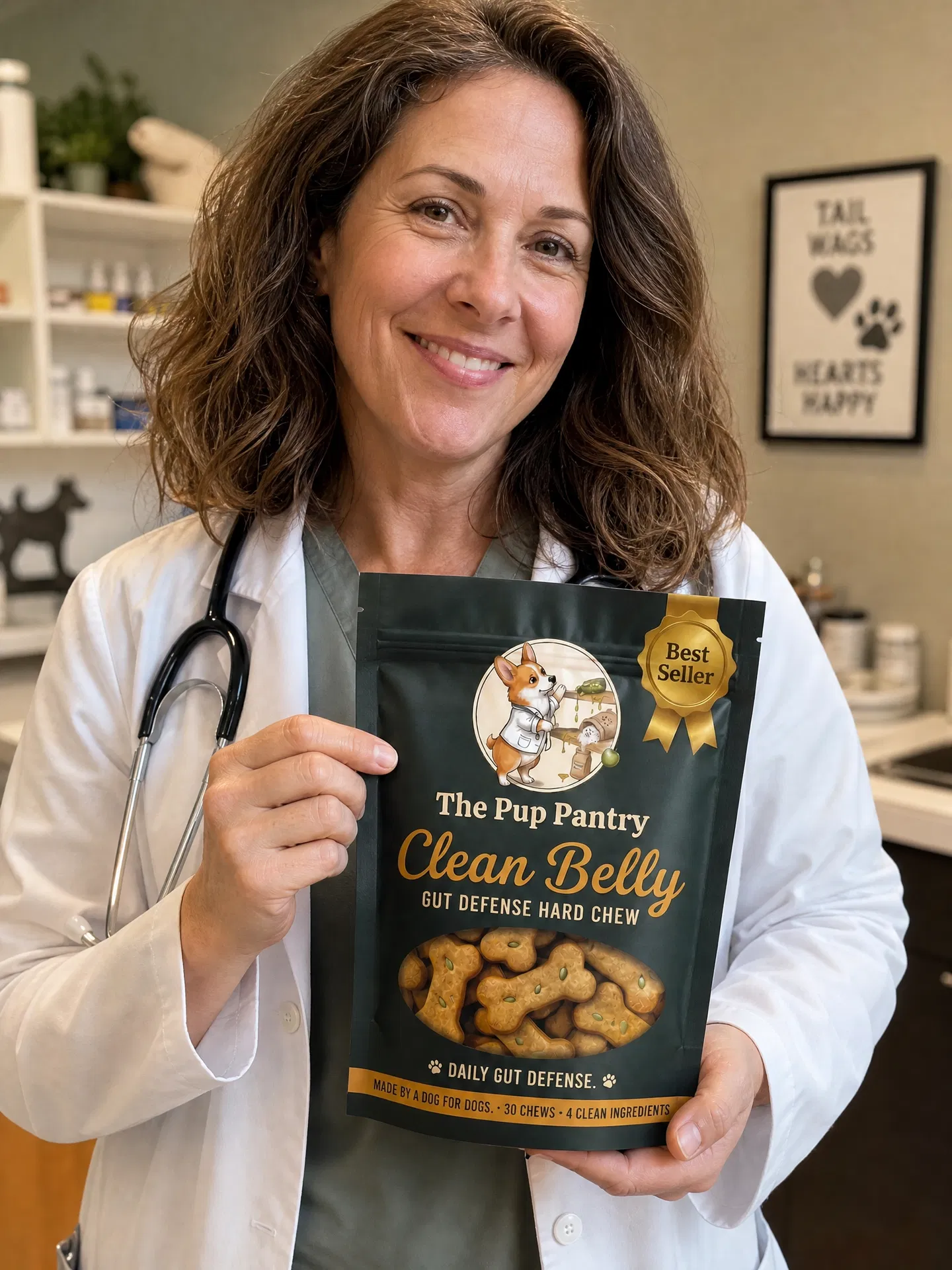
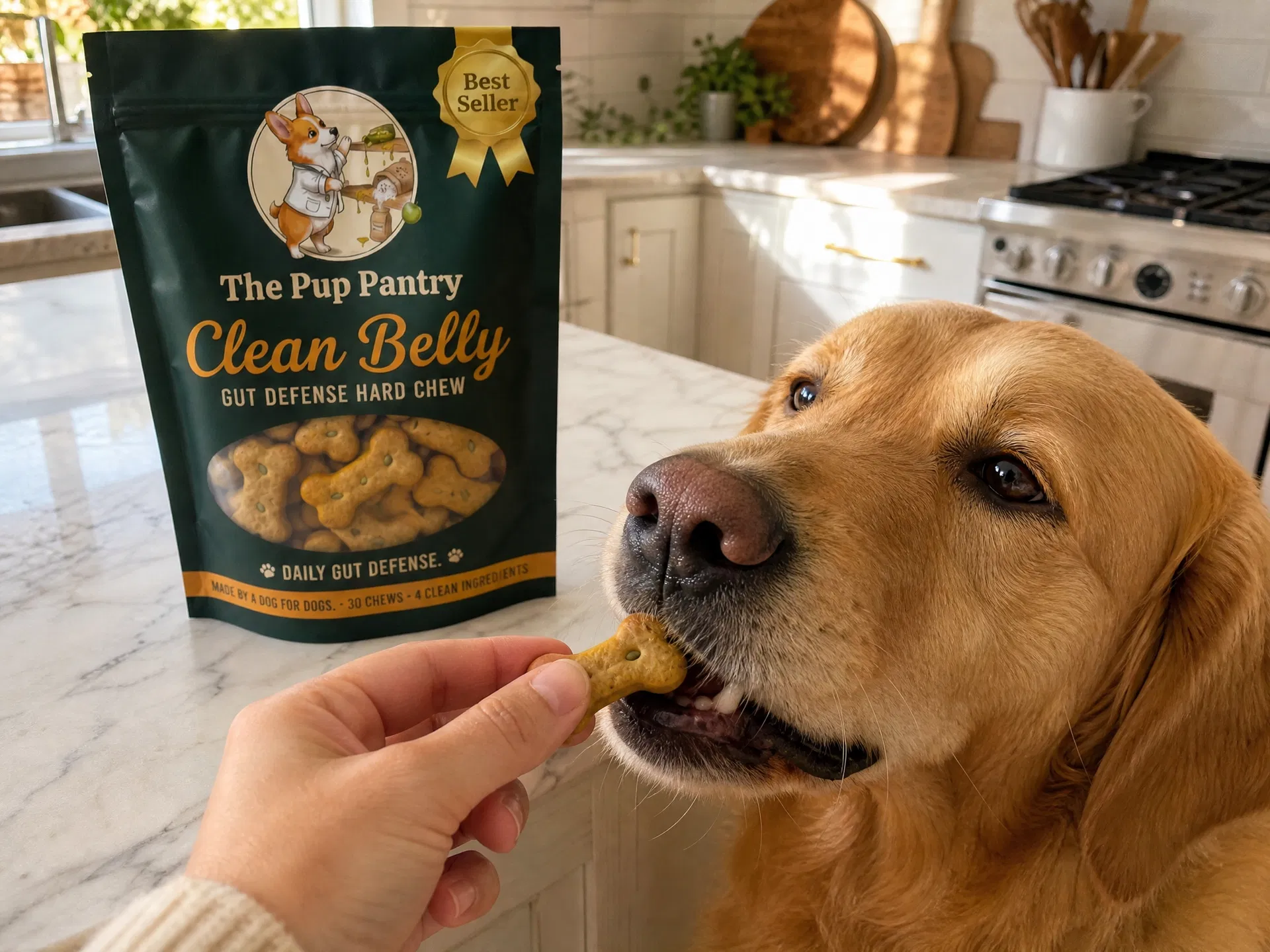
One company is making this full four-ingredient protocol available as a daily hard chew: Clean Belly by The Pup Pantry.
What Happens When You Actually Fix the Root Cause
When I introduced this protocol in my practice, the results surprised even me.
In a group of 200+ dogs with treatment-resistant chronic symptoms — including scooting, paw licking, indoor accidents, nighttime pacing, and reactivity — 184 showed meaningful improvement within 14 to 21 days.
Owners reported:
Scooting stopped completely within the first week.
Paw licking reduced dramatically. Some dogs stopped within days.
Indoor accidents resolved without any additional training.
Dogs finally sleeping through the night without pacing.
Reactivity on walks noticeably calmer.
Coat quality improving, with old bald patches growing back.
Stools firming up and becoming regular.
Karen tried it with Biscuit.
By day 5, the 3AM pacing stopped.
For the first time in two years, Karen slept through the night.
By week 2, Biscuit's paws weren't raw anymore. The scooting had completely stopped.
At week 3, Karen told me through tears:
"I feel like I have a different dog. He's calm. He's sleeping. He hasn't had an accident. I didn't know he could be like this."
And she wasn't alone.
What Normal Should Look Like
Most owners accept chronic symptoms as "just how their dog is."
❌ The scooting they've stopped noticing.
❌ The paw licking they assume is just a quirk.
❌ The indoor accidents they've blamed themselves for.
❌ The nighttime pacing that's cost them their own sleep.
❌ The reactivity that's made walks something to dread.
But that's not normal. That's preventable suffering.
With proper gut support and cleansing, dogs can:
✅ Sleep peacefully through the night.
✅ Have calm, regulated behavior on walks and at home.
✅ Stop the scooting, stop the paw licking, stop the accidents.
✅ Come off the Apoquel, come off the Cytopoint, come off the calming chews.
The unnecessary suffering is staggering.
Millions of dogs are living with this right now. Most of their owners have no idea what's actually wrong.
Why Act Now
Holistic veterinary circles are finally talking about the gut-behavior-skin connection openly.
Clean Belly is running a limited launch promotion right now. Buy 2 bags, get 1 free. Buy 3, get 2 free. Plus free shipping and a 90-day money-back guarantee.
The catch? Hard chews made with real whole-food ingredients are harder to produce than cheap filler supplements. Their supplier has limited capacity, and demand has been outpacing stock since they opened.
I'd grab it while the launch pricing is still running.
You Have Three Choices
Option 1: Keep using medications that don't address the gut damage. Keep watching your dog struggle. Accept that "this is just who he is."
Option 2: Try stronger prescriptions, behavioral medications, or another round with a new trainer. Hope this one works where the others didn't.
Option 3: Try the approach that addresses the gut damage causing the symptoms.
The choice seems clear to me. But it's yours to make.
Join Thousands of Dog Owners Who've Finally Seen Real Change
If you're ready to address the root cause, here's what to do:
- Click the button below to check if Clean Belly is still available.
- Choose your package. Most owners start with a 30-day supply and grab a second bag for month two.
- Give one chew each morning with food.
- Watch for first signs of improvement around days 3 to 7.
- Notice behavioral and digestive changes around weeks 1 to 2.
- Complete the full gut reset around weeks 3 to 4.
Remember: You're protected by the 90-day money-back guarantee. You have nothing to lose except the symptoms you've been managing for years.
CHECK AVAILABILITY AND CLAIM 50% OFFClick the link above to see if Clean Belly is still offering their limited sale
To your dog's recovery,
Dr. Laura Simmons, DVM
Integrative Veterinarian
© 2026 The Pup Pantry. All Rights Reserved. Privacy Policy | Terms of Use. These statements have not been evaluated by the Food and Drug Administration. This product is not intended to diagnose, treat, cure, or prevent any disease. Always consult a licensed veterinarian. Results may vary.